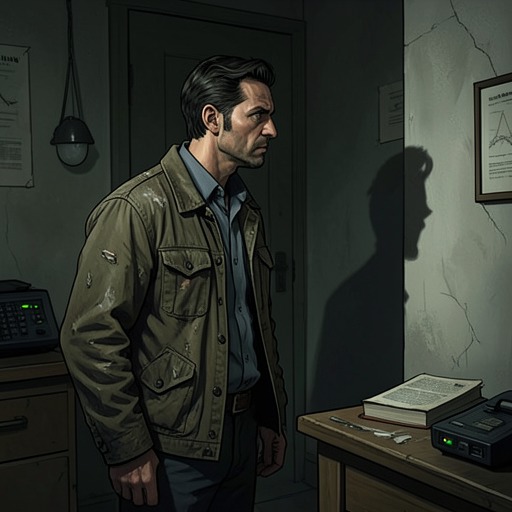
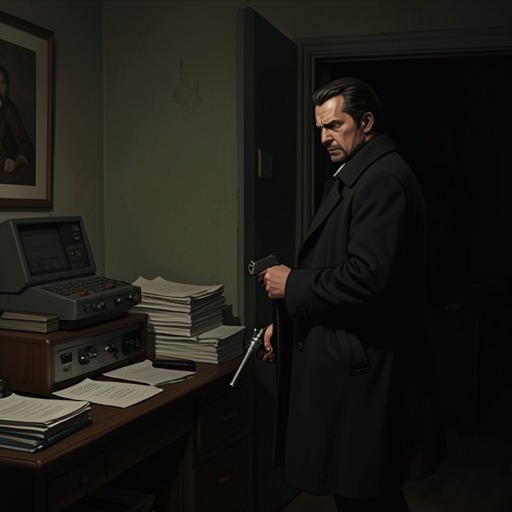
Edward George Ricks
The AxEdward George Ricks is a chemical engineer and experienced manager in the specialized paper industry, whose career history marks him as a close employment rival to Burke Devore. Burke targets him after harvesting résumés through a false job advertisement, then kills him at his home in Longholme. The encounter is not the controlled attack Burke intends: Edward’s wife mistakes Burke for another man, and the ensuing confusion ends with both spouses dead.
Identity and Professional Background
Edward’s résumé identifies him as Edward G. Ricks and records that he was born in Bridgeport, Connecticut, on April 17, 1946. He attended Bridgeport schools and earned a degree in chemical engineering from Henley Technical College in Broome, Connecticut, in 1967. These details establish a technical career grounded in formal training rather than merely general management experience.
From 1991 until the spring of 1996, Edward was in charge of the polymer paper film product line at Graylock. Its customers were almost entirely defense contractors, and recent military cutbacks led Graylock to drop the line. The résumé presents that change as the reason he is once again available to the industry: he offers his experience to another company in specialized paper, says he is willing to relocate, and notes that he has been based in Massachusetts since 1978.
Edward’s résumé also records a wife and three daughters, all attending university at the time of writing in 1997. It gives his address as 7911 Berkshire Way, Longholme, Massachusetts. Those concise details place professional displacement alongside a family life, but the document does not describe how unemployment affected the household or what Edward thought of his prospects.
A Rival Selected by Résumé
Edward enters the story first as a name in the pool of applicants gathered by Burke’s fabricated advertisement. Burke distinguishes him from less threatening applicants: in Burke’s judgment, Edward’s qualifications are very similar to his own, and his background and education might even give him an advantage. Burke imagines that, in a genuine competition for the advertised job, Edward could be the person to whom he would come second.
That assessment makes Edward dangerous in Burke’s private logic. Burke has turned an ordinary hiring process into a zero-sum contest in which another qualified applicant is treated not as a colleague or fellow unemployed manager, but as an obstacle to employment. Edward’s résumé supplies the evidence Burke uses to identify him, while its professional details become, in the killer’s mind, a reason to remove him. The narrative thereby connects the violence to the false advertisement: a document meant to solicit applications instead becomes part of Burke’s method for selecting victims.
The Attack at Longholme
Burke arrives intending to kill Edward, but Edward’s wife sees him and mistakes him for an older man who has been having an affair with her young daughter. She recognizes Burke’s face, sees his Luger, and runs toward the house screaming. Burke catches her on the lawn and shoots her from behind. Her cry for Edward carries the mistaken identity into the open; the murder is already witnessed by the household, and Burke’s attempt to keep the attack impersonal has collapsed.
The front door opens, and Edward appears in the doorway. Burke raises the gun and fires, but the bullet strikes the aluminum beside the doorframe. Edward slams the door and runs inside. Burke, exhausted from chasing his wife, tries the locked front entrance, then goes around through the open garage in pursuit. Edward emerges through the interior door, and Burke shoots him in the face. Edward dies on the garage floor, his body partly extending through the doorway into the house.
Consequences and Narrative Significance
The two deaths expose the difference between Burke’s plan and what happens at the Ricks home. He had selected Edward as a professional competitor and meant to kill him alone; instead, a mistaken accusation brings Edward’s wife into the encounter, and Burke kills her as well. His later confession explicitly acknowledges that he only intended to kill Edward and that his wife’s error and the confusion forced the second killing. That account confirms the central reversal: the murder of a résumé rival becomes a double murder in a domestic setting.
Edward’s death is also one of the crimes Burke eventually names in his confession, where he places the killings at the Ricks home in Longholme the previous Thursday. The résumé and the confession frame Edward from opposite ends of the story: first as a qualified applicant whose career resembles Burke’s, then as a victim whose death reveals the real cost of Burke’s effort to secure work by eliminating competition. Edward is given little narrated interior life; the force of his characterization comes instead from the professional record that makes him a target and the abruptness with which that record gives way to violence.